Vinted's New Terms and Conditions: What They Mean for Sellers
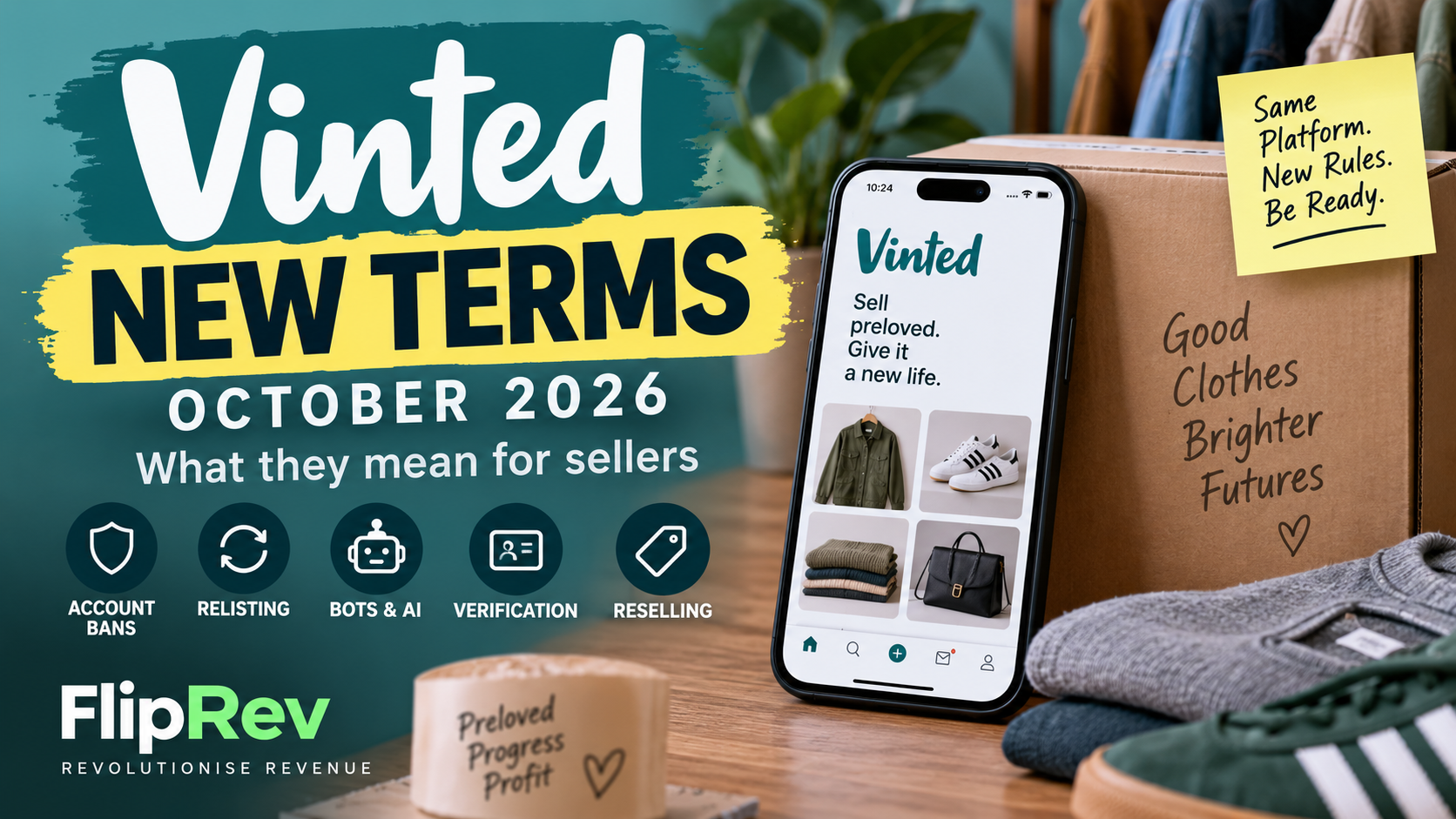
Vinted has updated its Terms and Conditions, with the new version due to take effect on 8 October 2026.
As you might expect, the update has caused plenty of discussion among sellers. Social media posts are already claiming everything from Vinted banning resellers to imposing strict limits on how many items people can sell.
But what do the terms actually say?
We've gone through them to pick out the parts that matter most to sellers, without the legal jargon.
Is Vinted banning resellers?
This is probably the biggest concern for anyone who regularly buys items specifically to resell for a profit.
Vinted's terms state that a standard account should be used:
"for your personal benefit only and not for any professional purposes"
The selling rules also state that an item must not be something originally purchased:
"in bulk or as a dropship product (as in, you don't physically have the Item) with a low resale value."
This wording is important.
It does not simply say that buying something cheaply and later selling it for a profit is prohibited. However, Vinted is clearly maintaining a distinction between ordinary personal selling and professional or commercial activity.
What does this mean for sellers?
If you occasionally buy something from a charity shop, car boot sale or elsewhere and later sell it on Vinted for a profit, these terms do not explicitly say that doing so automatically makes your account commercial.
If, however, you're regularly purchasing stock in bulk and operating what is effectively a retail business through a standard Vinted account, there is clearly more potential for Vinted to regard your activity as professional.
For regular resellers, this is an area worth watching closely.
Is Vinted limiting sellers to 24 listings?
We've seen claims circulating that Vinted's new terms mean sellers will only be allowed to have 24 listings.
We cannot find a 24 listing limit anywhere in the new Terms and Conditions supplied by Vinted.
There may be separate rules, limits or restrictions applied by Vinted in particular circumstances, but the updated Terms and Conditions themselves do not appear to introduce a blanket rule saying that users can only have 24 active listings.
So, based on the terms we've reviewed, there's no need to start panic deleting listing number 25.
Deleting and relisting items
This section is particularly relevant to regular sellers.
Vinted says users must not:
"delete and re-list the same Item multiple times or multiple Items in bulk"
Again, the wording matters.
It does not say that an item can never be relisted.
It specifically refers to repeatedly deleting and relisting the same item, or doing so with multiple items in bulk.
Sellers who routinely delete large numbers of listings and immediately recreate them to push their stock back up the catalogue should therefore take notice.
Advantage
This could reduce sellers repeatedly manipulating search results by constantly refreshing the same listings, potentially giving other sellers a fairer chance of being seen.
Disadvantage
Long term sellers often have perfectly legitimate reasons for refreshing old stock. Vinted's wording leaves some uncertainty around exactly where ordinary relisting ends and prohibited behaviour begins.
Vinted can use automated systems to detect violations
Vinted confirms that it may use automated tools to detect activity that breaks its Terms or Catalogue Rules.
Possible action includes removing listings, restricting account features, issuing warnings and temporarily or permanently blocking an account.
This is particularly relevant given the recent reports from users who say their accounts have been restricted or banned unexpectedly.
There is some reassurance in the terms.
Vinted says users will normally receive a written explanation when corrective action is taken and will be informed of their right to appeal.
Appeals can be submitted through Vinted's system and are reviewed under the supervision of qualified staff.
Advantage
Automated systems can help Vinted identify scams, counterfeit goods and genuinely abusive behaviour across a marketplace containing millions of listings.
Disadvantage
Automated moderation isn't infallible. Legitimate sellers can understandably find it frustrating if an automated system incorrectly flags a listing or account, particularly when selling expensive branded items.
If your account has been blocked, don't immediately create another account. Vinted's terms say it may prevent blocked users from creating a new one.
Bots, scraping and third party software
Anyone using automation tools with Vinted should pay particular attention to this section.
The terms prohibit the use of external software including:
- Bots
- Scraping programs
- Crawling programs
- Spiders
They also prohibit data mining, screen scraping and crawling parts of the Vinted website, unless that use has been authorised, offered or otherwise allowed by Vinted.
Advantage
This should help combat automated buying bots, spam, artificial favourites and other tools capable of giving users an unfair advantage.
Disadvantage
The wording is broad and may affect legitimate third party tools that interact directly with Vinted.
If you use software that automatically accesses Vinted, it is worth checking exactly how that software works rather than assuming it is permitted.
Vinted can use your photos and descriptions for AI
This is likely to be one of the more controversial sections.
Content uploaded to Vinted includes your listing photographs, videos and descriptions.
Under the terms, users grant Vinted and its affiliated companies a worldwide, royalty free licence to use that content.
The stated purposes include operating and promoting Vinted, but also:
"development and improvement of artificial intelligence (AI) and machine learning models"
Vinted can also use content for commercial, marketing and promotional purposes.
There is an option in account settings to stop your content being featured in marketing campaigns.
However, the terms we've reviewed describe that specifically as an opt out from marketing use. They do not state in this section that the same setting opts your content out of AI or machine learning use.
Advantage
AI systems could potentially improve search, categorisation, fraud detection and other features across Vinted.
Disadvantage
Some sellers will understandably be uncomfortable with their photographs and descriptions being used to develop AI systems, particularly when those images have taken considerable time and effort to create.
Be careful with designer items and Vinted Verification
This is an important one for anyone selling expensive branded goods.
If an item goes through Vinted's Verification Service and is considered counterfeit, Vinted can retain the item for six weeks.
During that period, the seller can challenge the decision and provide evidence of authenticity.
If satisfactory proof or a formal objection isn't provided within the retention period, the terms state that Vinted may:
- Dispose of the item
- Recycle it
- Destroy it
The seller may then lose the right to have the item returned and receive no compensation for it.
Advantage
Removing confirmed counterfeit goods protects buyers and legitimate sellers and helps prevent the same fake item simply being listed again.
Disadvantage
For sellers of high value designer goods, an incorrect authenticity decision could become a serious problem.
Keep receipts, authentication documents, serial number photographs and anything else that can demonstrate where an expensive item came from.
Vinted can ask you to prove your identity
Sellers need a Vinted Wallet to receive money from sales.
The new terms explain that Vinted's payment providers can carry out Know Your Customer, or KYC, checks.
Depending on the circumstances, you could be asked for documents including:
- Passport
- Driving licence
- Bank statement
- Proof of address
Further checks can also take place after your Vinted Wallet has already been opened.
If you fail or don't complete a required KYC check, your wallet may be suspended and your ability to withdraw money can be restricted.
Advantage
Identity verification helps combat fraud, money laundering and accounts created using false identities.
Disadvantage
Sellers may temporarily lose access to their balance while verification issues are resolved. It is therefore important that the name, address and banking information on your account are accurate and up to date.
You are only allowed one Vinted account
The terms continue to state that users are allowed only one account.
There are exceptions.
If Vinted blocked your original account because somebody unlawfully took it over, you may create another account.
Where Vinted Pro is available, a user may also have a personal account and a separate Pro Seller account, provided they use different email addresses and remain clearly separate.
If you've been banned for another reason, simply creating another account could therefore make the situation worse.
What happens to your money if Vinted blocks your account?
Being blocked doesn't automatically mean Vinted simply takes the money sitting in your account.
The terms state that users can generally complete pending transactions and payouts after an account is blocked.
There are exceptions.
Where there are security or fraud concerns, a compromised account, or other circumstances where restrictions are considered necessary, transactions may be cancelled and the ability to withdraw funds may be restricted.
That's an important distinction given some of the claims circulating online.
Vinted can end your account with 15 days' notice
The terms state that users can end their relationship with Vinted at any time by deleting their account.
Vinted can also end the agreement:
"at any time and for any reason by giving you 15 days' prior written notice."
Pending transactions and payouts remain covered by the terms until they have been completed.
This is another reminder that sellers shouldn't treat access to any marketplace as guaranteed forever.
International sales bring extra responsibilities
Vinted is also making provisions for more cross border transactions.
Your listings may potentially be visible to buyers registered in other countries.
For sellers, that can mean additional responsibilities involving:
- Product safety
- Intellectual property
- Customs
- Tax
- Import and export requirements
Some products permitted in one country may also be prohibited in another.
International selling could bring more buyers to your listings, but sellers should understand that it can also introduce additional responsibilities.
So, are Vinted's new terms bad for sellers?
Not necessarily.
There are sensible provisions here aimed at tackling fraud, counterfeit products, bots, fake accounts and manipulation of the marketplace.
There are also areas that regular sellers should pay attention to.
The distinction between personal and professional selling remains particularly important for resellers. Vinted is also clear about bulk relisting, external software, identity verification and its ability to restrict accounts where it believes its rules have been broken.
The expanded wording around the use of seller content, particularly for AI and machine learning, is also something users should be aware of.
Perhaps most importantly, don't panic because of something you've seen in a Facebook post.
Read what the terms actually say.
The advantages for Vinted sellers
Overall, there are some potential positives:
- Stronger action against bots and automated marketplace manipulation
- Greater protection against counterfeit items
- Identity checks that could make fraudulent accounts harder to operate
- Clearer information about what happens when an account is restricted
- A defined appeal process when Vinted takes corrective action
- Potential access to more buyers through international transactions
The disadvantages for Vinted sellers
There are also legitimate concerns:
- Continued uncertainty for people who regularly resell for profit
- Broad restrictions around third party software and automation
- Restrictions on repeatedly deleting and relisting stock
- Extensive rights for Vinted to use uploaded content, including for AI development
- Automated systems can be involved in enforcement decisions
- Expensive items that fail verification can ultimately be destroyed
- KYC checks can potentially restrict access to payouts while issues are resolved
- International transactions can introduce additional legal and tax responsibilities
What should Vinted sellers do now?
For most casual Vinted users, there probably isn't anything dramatic you need to do.
Regular sellers should take the opportunity to check that their account information is correct, avoid bulk relisting practices that could breach the rules and understand how any third party tools they use interact with Vinted.
If you sell expensive branded items, keeping good evidence of authenticity is increasingly important.
And if you're running a substantial resale business, it is worth remembering that Vinted is a third party marketplace. Your listings, sales history and access to customers ultimately depend on an account that Vinted controls.
Keeping your own independent records of stock, purchase costs and sales is always sensible.
When do the new Vinted terms take effect?
The updated Terms and Conditions state that the new version is applicable from 8 October 2026.
Vinted says that for changes requiring acceptance, users will have 15 days from receiving notice to accept the new terms.
If you don't agree with the changes, Vinted says you can close your account free of charge after any pending transactions have been completed.
Final thoughts
There's plenty in Vinted's updated terms worth knowing about, but some of the reaction online appears considerably more dramatic than the wording itself.
No, we haven't found a new rule saying everybody is limited to 24 listings.
No, the terms don't simply say that making a profit on an item is banned.
But yes, Vinted is clear that ordinary accounts are intended for personal rather than professional use, it restricts certain forms of bulk relisting and automation, and it gives itself extensive rights over content uploaded to the platform.
For regular sellers, those are the areas worth paying attention to.
The best advice is simple: understand the rules, keep good records, keep evidence for valuable items and don't build your entire reselling operation around the assumption that access to any single marketplace is permanent.
This article is an independent summary of Vinted's updated UK Terms and Conditions and is intended for general information only. It is not legal or tax advice. FlipRev is not affiliated with or endorsed by Vinted.